The always interesting Sociological Images posted today about travel guides from the mid 20th century that helped African-Americans navigate through hostile territory. Right now I'm reading (among other titles) Cadillac Chronicles, about a contemporary high school boy taking a road trip with an elderly African-American man. Indeed, just this morning I got to the bit when they're involved in a bit of an altercation at a truck stop in South Carolina (I think) because a white fellow didn't like the looks of the two of them.
Showing posts with label YA lit. Show all posts
Showing posts with label YA lit. Show all posts
Wednesday, January 30, 2013

Saturday, September 22, 2012
National Book Festival
I left my cozy home this morning at 6:40 a.m. to drive about 100 miles to D.C. to see John Green and it was totally worth it. Even after finding my favorite parking deck apparently closed, I was still in a folding chair before 9:00 -- and I was far from alone.

Just like I've seen in any number of Vlog Brothers videos, young people about 15 - 19 dominated the crowd. They wore Nerdfighters t-shirts, Dr. Who t-shirts, funky hair, silly hats, cute dresses, comfy jeans. A young woman near by perused the schedule aloud with her friends. She spotted -- well which name first? R.L. Stine, or Michael Grant who co-wrote Animorphs? One name triggered a memory: she told her friends about reading nothing but Goosebumps for all of third grade (or whatever it was) and gobbling up Animorphs. And yet here she is at 19 or so, reading literary fiction by Green and talking about his works and other challenging books with her friends. She's evidence that popcorn reading doesn't hurt you: she found something she loved, and learned to love reading in general. Sitting near her made me feel completely okay about selecting books for my library that are so-so writing but super-popular.
Not long after that bit of awesomeness, a voice behind me gushed to her friends, "There are so many glasses in this crowd -- it's such a cute group of people." One friend replied, "I just want to give everyone a hug."
That's just how I felt, too -- only with the weird barrier of knowing I was about their parents' age, so I had no business hugging anyone. Well, except for Sheila! Who I saw off to the side standing with her teen kids! Oh, and my work friend Mary (who, I know, is tall, but I forget I'm not, I guess? So this picture surprised me). She actually served as manager of the teens tent: she must be exhausted by now.

Green himself appears just as he seems online: bright, a little stressed and hair-tugging; dedicated to letting intelligent teens know they are not alone in their smarts, and in their quest for answers. Green praised M.T. Anderson, another author who knows teens are smart, before launching into the tale of their urban exploration from a few years back. Green exuded warmth and genuineness about the community that is Nerdfighers. He values the dialogs he has with them and which he prompts between them; he's proud of the charities they support and of the things the fans are inspired to create because of him and his brother. Being in the tent with nerd-love made the drive worthwhile. I could have gone straight home.

I didn't though. The rest of my morning was spent failing to have any phone service, or much time on the free wireless before it dropped me -- so I couldn't find anyone else I knew. I looked in on the Library of Congress exhibits, then decided to bag it, and went to the National Gallery.

I ate lunch, and took a look at a George Bellows exhibition. Seeing so many of his boxing paintings (and drawings) at once emphasized that there were certain moments, certain lines, he liked to capture. There were portraits of the poor, with very creepy, hollow eyes -- like the Other Mother in Coraline, or sad-eye paintings from the 1970s. Many cityscapes appeared, too. One from 1911called simply New York blew me away. So much movement, so much New York.
It hung on a wall perpendicular to A Day in June (1913), a vibrantly green picture (ok photo, here), that's so much quieter and emptier that it's weird to think it's the same city, and artist.
Refreshed by art, I checked back in at the teen tent, heard Lois Lowry say "last question" and give a reply along the lines of remembering the past is critical if we don't want to repeat mistakes. Despite that advice, I failed to rediscover 395 south the easy way and took a sort of mistaken alternate route to the highway.
audiobook for the trip: The Westing Game, by Ellen Raskin
seen on I-95: tree removal south of Quantico, suggesting more lanes in the futre

Just like I've seen in any number of Vlog Brothers videos, young people about 15 - 19 dominated the crowd. They wore Nerdfighters t-shirts, Dr. Who t-shirts, funky hair, silly hats, cute dresses, comfy jeans. A young woman near by perused the schedule aloud with her friends. She spotted -- well which name first? R.L. Stine, or Michael Grant who co-wrote Animorphs? One name triggered a memory: she told her friends about reading nothing but Goosebumps for all of third grade (or whatever it was) and gobbling up Animorphs. And yet here she is at 19 or so, reading literary fiction by Green and talking about his works and other challenging books with her friends. She's evidence that popcorn reading doesn't hurt you: she found something she loved, and learned to love reading in general. Sitting near her made me feel completely okay about selecting books for my library that are so-so writing but super-popular.
Not long after that bit of awesomeness, a voice behind me gushed to her friends, "There are so many glasses in this crowd -- it's such a cute group of people." One friend replied, "I just want to give everyone a hug."
That's just how I felt, too -- only with the weird barrier of knowing I was about their parents' age, so I had no business hugging anyone. Well, except for Sheila! Who I saw off to the side standing with her teen kids! Oh, and my work friend Mary (who, I know, is tall, but I forget I'm not, I guess? So this picture surprised me). She actually served as manager of the teens tent: she must be exhausted by now.

Green himself appears just as he seems online: bright, a little stressed and hair-tugging; dedicated to letting intelligent teens know they are not alone in their smarts, and in their quest for answers. Green praised M.T. Anderson, another author who knows teens are smart, before launching into the tale of their urban exploration from a few years back. Green exuded warmth and genuineness about the community that is Nerdfighers. He values the dialogs he has with them and which he prompts between them; he's proud of the charities they support and of the things the fans are inspired to create because of him and his brother. Being in the tent with nerd-love made the drive worthwhile. I could have gone straight home.

I didn't though. The rest of my morning was spent failing to have any phone service, or much time on the free wireless before it dropped me -- so I couldn't find anyone else I knew. I looked in on the Library of Congress exhibits, then decided to bag it, and went to the National Gallery.

I ate lunch, and took a look at a George Bellows exhibition. Seeing so many of his boxing paintings (and drawings) at once emphasized that there were certain moments, certain lines, he liked to capture. There were portraits of the poor, with very creepy, hollow eyes -- like the Other Mother in Coraline, or sad-eye paintings from the 1970s. Many cityscapes appeared, too. One from 1911called simply New York blew me away. So much movement, so much New York.
 | ||
| George Bellows New York, 1911 Collection of Mr. and Mrs. Paul Mellon 1986.72.1 National Gallery image |
It hung on a wall perpendicular to A Day in June (1913), a vibrantly green picture (ok photo, here), that's so much quieter and emptier that it's weird to think it's the same city, and artist.
Refreshed by art, I checked back in at the teen tent, heard Lois Lowry say "last question" and give a reply along the lines of remembering the past is critical if we don't want to repeat mistakes. Despite that advice, I failed to rediscover 395 south the easy way and took a sort of mistaken alternate route to the highway.
audiobook for the trip: The Westing Game, by Ellen Raskin
seen on I-95: tree removal south of Quantico, suggesting more lanes in the futre
Monday, May 21, 2012
On Thursday, I finished Tanita Davis's Happy Families, about a family with a father coming out as transgender; then on Sunday I read an article about a family at the other end, with a small child who is transgender. That story, in the Washington Post, is here; and here's the short blurb I wrote for my Shelfari to help me remember the book so as to suggest it appropriately* to readers:
*which is the point of my Shelfari, all the time
Ysabel and Justin, twins, have a great family. Each twin pursues a passion -- making glass jewelry and debate team; mom has a catering business and dad's a businessman; they're close to their grandparents, and are active in their church. Then dad comes out as transgender and moves out. Much of the action of the novel happens during the spring break Ys and Justin spend with Dad, going to a therapist and participating in activities with a support group for families with transgendered person in them. The twins are mad and confused, each in his/her own way -- will the Nicholas family find its way back to happy?
Terrific realistic fiction with conflicts small and meta, teased out at a pace that is slower and thoughtful where it needs to be, and fast in enough places to keep us wondering what's next. Would be fine for a middle schooler who needs/wants to know about a transgender person as there's (almost?) no swearing, no sexual content. Useful appendix explains terms, instructs which terms are offensive.
*which is the point of my Shelfari, all the time
Saturday, February 04, 2012
Not That There's Anything Wrong with Girls
I've been following with enjoyment Hank & John Green's Tour de Nerdfighting and am struck by how full of screaming girls their audiences are. (The video at this post seems typical.) I can figure out lots of easy and even complicated reasons for this having to do how we've socialized girls to shriek at males they find compelling and/or cute and socialized boys that showing enthusiasm for other males isn't a good idea.
But given stats about boys falling behind in their ability to do sustained reading and given promising projects like Guys Read and excellent blogs like Guys Lit Wire it seems like an opportunity to give regular guys two great role models of writing, creating, and reading young men has gone to waste.
Thursday, December 15, 2011
I've been thinking about genre fiction. Pull it out in separate shelving? Cover library book spines with little heart and spy glass and vampire fang stickers? Use tagging on Teen Scene to point readers in the right direction? Beyond those mechanics, there's the stuff I didn't get in library school, much of which seems to have to do with using expressions like "appeal factors" and "pacing."
Explorations, serious and not, have caught my eye, too; the most recent is Adam Gopnik's piece in The New Yorker, "The Dragons Egg" (December 5, 2011, p. 86). He explores high fantasy, with just a few titles as touchstones: The Lord of the Rings, The Once and Future King, Eragon, and he throws in Twilight as a contrast. The appeal factors of high fantasy include "cool parts" and complicated mythologies; "gratification comes from the kid's ability to master the symbols and myths of the saga, as with those eighty-level video games, rather than from the simple absorption of narrative." Meanwhile, "the genius of the narrative [of Twilight] lies in how nearly the familiar experiences are turned into occult ones. . . . [t]he tedious normalcy of the 'Twilight' books is what gives them their shiver. . . ."
I want to keep processing tidbits on genre fiction, so I'd better make myself a blogger label.
Waiting on Wednesday
I'm a day late, but I feel the urge to play along with the meme that asks, What forth-coming book are you eagerly awaiting?
I did some book ordering today, and Cinder, by Marissa Meyer sounded swell to me, and had good reviews already in place in our book dealer's database. Our Teen Advisory Board kids get a chance to read 2 - 3 publisher blurbs and "vote" on books they'd like to see in the library. Maybe one kid (out of 6 in attendance) marked this title. But my gut reaction is to agree with Abby the Librarian who sums up the appeal this way, "What if Cinderella was a cyborg? (I mean, seriously, if that question doesn't intrigue you, I don't think we can be friends.)" So, I've ordered one for my library.
Wednesday, September 21, 2011

Idea 237: make a bookmark. And yes, I will slip it into a book when I get to work. Perhaps something by Sarah Dessen or Lurlene McDaniel
45/52
Thursday, April 21, 2011
Reading
I met author Candace Fleming at a Virginia Library Association conference a few yers back. I hadn't read her books, yet (my lib classifies them as JUV). She was receiving a prize and gave a wonderfully funny history-nerd speech. I bought two books, and when she signed them I told her "you're a kids' book-writing Sarah Vowell!" And I meant it.
At my old branch I helped people of all ages, all day, so knowing good JUV authors is helpful; sadly the county doesn't get many of Fleming's books, and most are at the big libraries. Now I work at a big library, and when I spotted Amelia Lost on the children's librarian's desk and went "ooh," she let me have it first. It took awhile to pick it up: "I know how it ends," I whined to myself. "It'll be sad."
Well, it is sad, but, wow what a good read! I love how Fleming builds excitement by weaving in one-page (usually) descriptions of the day the plane lost contact and all the people who thought they picked up distress signals from Earhart. Fleming even takes time to explain radio technology and culture of the time so that makes sense. The book is illustrated with period documents, ephemera, and photos. A great, suspenseful tragic read that I'll recommend to kids in grades 4 to 8. (Or, really, older. Even a high schooler who can hack an adult bio would enjoy this; it doesn't present little kiddish.)
P.S. I don't often blog about books anymore, but I want to turn in this book before the weekend. I like to make notes before returning so I'll know if there's swearing or sex or whatever before suggesting a book to a kid. But I couldn't make notes today because Shelfari is down, and has been since about 3:00. Shelfari -- now a subsidiary of Amazon (more rightly named than we knew? A giant monopoly in the making?) -- to add insult to injury, is suggesting I amuse myself by downloading something for my Kindle while I wait! Some damn nerve.
Saturday, February 19, 2011
Matched by Ally Condie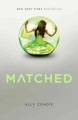
As is the custom in the Society, Cassia goes to be Matched at seventeen -- to by video screen the man she will marry at 21. She's thrilled by the event -- then shocked and thrilled to be Matched with her childhood friend. Being Matched with someone you know is nearly unheard of. So are mistakes, in the Society, but it seems one has been made.
Though reminiscent of a slew of great stories (Feed, Uglies, Hunger Games), Condie expresses nifty dystopian ideas quite well:
Or when another character tells Cassie about the myth of Sisyphus:

As is the custom in the Society, Cassia goes to be Matched at seventeen -- to by video screen the man she will marry at 21. She's thrilled by the event -- then shocked and thrilled to be Matched with her childhood friend. Being Matched with someone you know is nearly unheard of. So are mistakes, in the Society, but it seems one has been made.
Though reminiscent of a slew of great stories (Feed, Uglies, Hunger Games), Condie expresses nifty dystopian ideas quite well:
The almost-snow reminds me of a line from a poem we studied this year in Language and Literacy: "Stopping by the Woods on a Snowy Evening." It is one of my favorites of all the Hundred Poems, the ones our Society chose to keep, back when they decided our culture was too cluttered. They created commissions to chose the hundred best of everything: Hundred Songs, Hundred Paintings, Hundred Stories, Hundred Poems. The rest were eliminated. Gone forever. For the best, the Society said, and everyone believed it because it made sense. How can we appreciate anything fully when overwhelmed with too much? (p. 29)
Or when another character tells Cassie about the myth of Sisyphus:
"I don't know if he's real," Ky says. "If he ever existed."A thoughtful and gentle introduction to dystopias.
"Then why tell his story?" I don't understand, and for a second I feel betrayed. Why did Ky tell me about this person and make me feel empathy for him when there's no proof that he ever lived at all?"
Ky pauses for a moment before he answers . . . ."Even if he didn't live his story, enough of us have lived lives just like it. So it's true anyway."
Thursday, February 17, 2011
YALSA article on the Printz Award
Looking at all recipients to date, themes emerge. The books feature journeys, angst, romance and more. The authors also discuss the problem of identifying "best." Article, here.
Looking at all recipients to date, themes emerge. The books feature journeys, angst, romance and more. The authors also discuss the problem of identifying "best." Article, here.
Monday, January 31, 2011
Covers, Judging Books by
This blog entry features a history of covers for the same book by Lois Lowry. I really like not only the eeek-that's-dated feel, I also like that her publisher seems to have done a nice job keeping up with the styles of the day. And remember, fashion can change fast for kids.
Yet, I am still shocked to find that books with terrible 1980s covers have checked out of my lib recently. I don't know if some kids are drawn to the old-fashioned covers, if they are blind to the datedness, or if some grown up made them get a book and the kid just grabbed the skinniest thing she saw.
See also:
Awful Library Books
Guys Lit Wire "Get Past this Cover!"
"Cover Stories" stories at Reader Girlz.
Saturday, January 22, 2011
Thursday, November 18, 2010
Bad Teen Librarian
When, in a nyquil-induced haze, I heard the announcement of the National Book Award on the radio this morning, I thought the "young people's" book was The Mockingbirds (by Daisy Whitney), which I remembered from blurbs as being about mean girls -- it turns out it's also about surviving date rape. I fretted people would confuse it with Mockingjay, the last of the Hunger Games series. It turns out, the winner is Mockingbird, by Kathryn Erskine, about an eleven-year-old with Asperger's.
I gotta pay more attention.
Wednesday, October 27, 2010
Place Holder
I'm not sure why I am not using delicious to save this blurb on interfiling YA genres. I'm just sticking it here, okay? I do plan to take out separate genre shelves -- I mean it.
I'm not sure why I am not using delicious to save this blurb on interfiling YA genres. I'm just sticking it here, okay? I do plan to take out separate genre shelves -- I mean it.
Tuesday, October 26, 2010
Reading
Earlier, a mom of two girls in the uniform of their private (Christian) school got my help deciding if Patterson's Angel Experiment would be appropriate for the younger girl. I began with the usual: Well, YA includes books for kids in grades 6 to 12, so it covers a lot of ground. Then we moved to: Let's see what some reviews say. Turns out most said grade 7, and I also read buzz words like suspense, thriller, action, and even "graphic laboratory scenes" just to be sure I wasn't leading the mom astray. She said, Oh, that's fine as long as it's not . . . you know. Which I guess means sex?
Now, I've got VOYA (June 2010) in front of me, and there's a nice interview with Blake Nelson (whose books I now want to read!). After some discussion of including a sex scene, the interviewer asks "Do you find it sad that our culture is so much more accepting of violence than it is of making love?" To which Nelson replies, "Yeah it's weird, . . . [P]arents let kids play computer games all day where you just shoot Middle Eastern people in the head all day, but then freak out if the same kid reads a book where someone has sex."
Not exactly the situation I'd just had, but similar enough to note it, I think.
Friday, September 24, 2010
Picking Sides
Perhaps the best way to see if I am Team Zombie or Team Unicorn is to assess each story. (Note to anyone wanting to rush out and get the book for a young person: there's a good bit of swearing and some mature themes: it's not the next thing to get your fan of Goosebumps books.) (Note to self: can I stack up colons like that?)
Zombies vs. Unicorns, Justine Larbalestier and Holly Black, editors (2010)
"Highest Justice," Garth Nix - middle-weight fairy tale (unicorns: +2)
"Love Will Tear Us Apart," Alaya Dawn Jackson - pretty good love story; why do I feel like I don't get the ending? (zombies: +2)
"Purity Test," Naomi Novik - after various bit of suspense and bloodshed, ends with the line "okay - you know what, just shut up and give me some more chocolate milk." (unicorns: +4)
"Bougainvillea," by Carrie Ryan - elaborate, sad, bloody (zombies: +1)
"A Thousand Flowers," Margo Lanagan - medieval, sad, upper-tier fairy tale (unicorns: +3)
"Children of the Revolution," by Maureen Johnson - hauntingly awesome; captures the college-aged woman's voice perfectly (zombies: +5)
"The Care and Feeding of Your Baby Killer Unicorn," Diana Peterfreund - freakin' awesome killer unicorn story, layered in with the a teen's struggle to know what her faith calls upon her to do (unicorns: +5)
"Inoculata," Scott Westerfeld - he's such a masterful describer of post-apocalyptic worlds and he captures/creates the language of young people so nicely that I'll give this one high marks even though bits are a lot like Ryan's The Forest of Hands and Teeth (zombies: +4)
"Princess Prettypants," Meg Cabot - this hysterical story is the only thing by Cabot I have really liked! I may have to give her books another chance. (unicorns: +5)
"Cold Hands," Cassandra Clare - heavy-duty fairy tale-with-implied-lesson. Damn. (zombies: +4)
"The Third Virgin," Kathleen Duey - poignant; wished it had more depth (unicorns: +3)
"Prom Night," Libba Bray - while I love her off-the-wall humor: an ugly prom dress is an "unholy union of Hot Topic and mother-of-the-bride," another bleak zombie story is another bleak zombie story. Or were those fireworks a symbol of hope? (zombies: +3)
Looks like Team Unicorn for me! It strikes me that there's more room for variation in world-building for unicorns than for zombies, but great writing can take the day.

See also: Tor's interview with the cover artist, Josh Cochran.
Monday, June 28, 2010
Even the New Yorker Has Something to Say about YA Lit
For a nice introduction to dystopian novels for teens, take a look at t Laura Miller's article "Fresh Hell" in The New Yorker (June 14 & 21, 2010). She focuses on Suzanne Collins' fine Hunger Games, gives Scott Westerfeld's Uglies its due, and notes other works.
Miller notes why such novels -- series, often -- appeal: with so many hovering parents, any adventure is welcome; the pool of ideas is deep, and as "new" readers, teens don't mind if the plot is kinda like that one Twilight Zone episode; and they are not didactic. In fact, she asserts
Dystopian fiction may be the only genre written for children that's routinely less didactic than its adult counterpart. It's not about persuading the reader to stop something terrible from happening -- it's about what's happening, right this minute, in the stormy psyche of the adolescent reader.To sum up, Miller points us to Westerfeld's observation that perhaps dystopias appeal "'partly thanks to high school being a dystopia.'" Even if the machinations of the dystopia change, Miller predicts, the appeal to teens of stories set in a broken world, won't go away.
Tuesday, June 22, 2010
Great Book
As ever, I don't remember why Evolution, Me & Other Freaks of Nature by Robin Brande appeared on my To Read list. I do know that I am digging her writing! Check out this scene in a high school science class:
As ever, I don't remember why Evolution, Me & Other Freaks of Nature by Robin Brande appeared on my To Read list. I do know that I am digging her writing! Check out this scene in a high school science class:
Didja like it? Go get a copy!
The teacher, Ms. Shepherd says, "Because if you don't believe in evolution, then you must not believe that diseases change over time. In which case, there wold be no need for anyone to get new flu shots every year, because obviously if we've been vaccinated once, that should last forever, right?"
"Brilliant," Casey whispered.
"Just something to think about," Ms. Shepherd said. And then the bell rang.
And I just sat there. I didn't want to move. I wanted to sit there and understand everything I'd just heard.
Because until that moment, i was only sort of paying attention. I was treating biology like any other one of my classes -- just something to learn so I could get a good grade and move on. I appreciated that Ms. shepherd was making it fun and interesting, but it was still just a class.
But as of today, I have to admit: I have a crush on science.
Can you love a thought? Can you love a concept?
Nor to be too dramatic, but when Ms. Shepherd explained that about the flu shot and about us all being freaks of nature, it was like something reach inside my chest and yanked on my soul. Like somebody opened up my head and shouted down into my brain, "Do you get? Mena, are you listening?"
Wednesday, June 16, 2010
Late Last Night
After signing up folks for our Summer Reading Club, it had gotten pretty quiet at my lib. I might even admit to having zoned out for a bit. At about 8:44, I had to snap back into action and do readers' advisory for a reluctant reader (teen boy) and for a young man (teen, 20-something?) who wanted science fiction recommendations. Between them, Intertwined, one of the James Pattersons, Feed, Leviathan, and a couple of other things went out the door -- just in time to lock up at 9!
Despite this, I have got to brush up on my s/f.
Saturday, April 17, 2010
Controlled Vocabulary vs Natural Language
I just finished Libby Bray's witty, dark, deep Going Bovine and added it to my Shlefari. "How shall I tag it," I asked myself (yes, I not only talk to myself, I also use words like "shall" - deal with it). I never remember if I prefer "urban fantasy" or "alt fantasy"; should I choose "death and dying" from the suggested tags?; "road trip" goes without saying.
Then, for whatever reason, I took a look at the catalog record: "automobile travel - fiction" and "Bovine spongiform encephalopathy - fiction" and "dwarfs - fiction" -- seriously? I never considered that buddy Gonzo's dwarfism was part of the "aboutness" of the book. And why on earth isn't "road trip" a proper subject heading?
One thing subject headings (controlled vocabulary) and tags (natural language) can do is get us back to the book, even if it word or scene in our mind isn't a critical part of the book's aboutness. Imagine a patron saying, My friend told me about this book about a guy with mad cow disease who goes on a road trip with this other guy and they pick up a talking yard gnome. You'd want to try key words like "road trip" and "yard gnome" in your search. In library school, we certainly didn't memorize massive lists of subject headings, but we know how they work. Through practice, we learn to type things like "theater vocational guidance" to replace the patron's "get theater jobs" and, it seems, "automobile travel" for "road trips."
Subscribe to:
Posts (Atom)