I'll Show You "Yelling"
Not long ago, co-worker B and I were talking about a county customer service class she'd just taken -- I think it's the one with the title "It's Not What You Said, It's How You Said It." Instead of remembering the gist of what she told me she learned, I remember that I shared with her that I had lately noticed myself saying, "I'm sorry, we ask that you use your cell phone outside." I have nothing to be sorry about: it's the rule; it's posted on the door, and in about four places inside the building; and it's good manners. Why start off in such a naby-pamby way?
On the one hand, opening with "I'm sorry," is weak; might it be better to open with more authority and avoid weakness? On the other, I guess "I'm sorry" stands in for "Excuse me for interrupting your conversation." More importantly, I find that saying nearly exactly that, to every single person, every time means that grouchy patrons can't accuse me of being rude, singling them out -- or "yelling."
From the ref desk yesterday, I heard sustained conversation from 2/3 of the way across the building. I went to investigate and found a 60-something year old man chatting away on the phone. I said in a quiet voice, "I'm sorry, we ask...." He glanced at me, said into the phone "I'm in the library. And the other thing about blah, blah, blah," and kept browsing DVDs. Maybe he's hard of hearing? "Sir," I began again, "please use your phone outside." "Hold on," he said into phone, "I'm in the library and she's yelling at me."
"Thank you," I said, walking away.
Yelling?! I'll give you yelling: "Outlook! Time to line up," so that it can be heard at tent 6. "Good morning, Pine Ridge!" loud enough that 2 out of 8 teens lift their heads off the pillow. Then there was a classic shouting fit between me and my freshman year roommate at MHC. . . . Buddy, if I "yell" at you, your friend on the other end of the line will know it, not need to be told.
Capital City weather: rainy
Friday, May 18, 2007

Thursday, May 17, 2007
Monday, May 14, 2007
Reading
The next book club book for the Lib. is The Wal-Mart Effect.... Based on the way the group went after The Tipping Point, it's going to be quite a discussion! Here's a bit I like:
And another:
Now that is a good tip -- and easy to check up on.
Oh, dear, knowing that some of our folks take exception to everything in every book, I better start researching that one if I plan to used it in discussion!
The next book club book for the Lib. is The Wal-Mart Effect.... Based on the way the group went after The Tipping Point, it's going to be quite a discussion! Here's a bit I like:
Although Wal-Mart has stayed true to its original core value -- always low prices -- the company has now grown so large, and evolved in so many ways, that it no longer truly understands its own culture clearly or effectively -- or understands how it is perceived by the rest of us. The mascot of the company is the bouncing yellow smiley-faced price chopper. But while the prices at Wal-Mart may make us smile, Wal-Mart itself almost never does. This, too is part of the Wal-Mart effect. . . . (p. 13)
And another:
(In general, when a Wal-Mart can't keep the letters in its lit, the store is a mess.)
(p. 17)
Now that is a good tip -- and easy to check up on.
Oh, dear, knowing that some of our folks take exception to everything in every book, I better start researching that one if I plan to used it in discussion!
Saturday, May 12, 2007
400 Years Ago this weekend some dudes from England sailed up the Powhatan River (now the James), said this is out of the sight of those dangerous Spaniards: let's set up here. James Fort saw some terrible times, sprouted New Town to the west, and faded as the capital of the royal colony moved to Williamsburg.
Today, Phiance and I scurried east on I-64 bright and early -- well, overcast and early -- and stepped out of all the PBS specials and books into live-action history.
Curiously, the satellite parking lot we chose ("Yellow") turned out in fact to be Eastern State. But our timing was great and there was no wait to pay or to board a school bus for a ride to Jamestown Settlement. As dedicated history nerds, from there we got ourselves on the next school bus to "The Island" -- i.e., Historic Jamestowne. At the site of the 1607 fort, we heard archaeologists speak on the ongoing work uncovering the fort than generations of us learned was lost to the River. "I loved your book," Phiance said to Dr. Kelso himself slipped out of the current dig after a quick look at an area that might be the site of a 1609 well. We saw a bits of a sword and bones from a meal sticking out of the ground. By the River workers doing inital sifting showed us a faceted green bead and brass(?) aglets. Awesome.
The new Archaearium, a striking copper-clad building that floats above the ground, houses the infamous ear picker, a replica of the skeleton found with a bullet in the leg, a bit of a shoe, buttons, ceramics, beads brought for trade, and all the other wonderful finds. We also some cool interactive viewers, where Phiance befriended a couple from Gloucester, with whom we later shared a river-side picnic table. Visitors point the view camera out the window and are offered choices of videos on the thing in the viewfinder.
Noon found the sun fully out and us in the shade of a holly tree to listen to Martin Gallivan, the archaeologist on the Werowocomoco project. I've been following the story of the work to uncover Powhatan's town since my friend was asked to join the Indian Advisory Board. With his back to the James, Dr. Gallivan outlined the project clearly and with enthusiasm. His computer slides appeared on a jumbotron kind of thing to his left. We had a great view of him, as nearly no one sat in the sun-warmed seats in front of us, and I enjoyed gazing off towards the River or into the trees as he spoke. I started to feel badly that so few people came to hear him, but as I gazed round behind me, I could see dozens more people in the shade.
Dr. Gallivan was followed by the Indian drum Four Rivers. Voices joined the beat as I was again looking to the River, and that was the most moving moment of the day.
The Island has been transformed since we visited two years ago, so as we ascended to the obelisk erected in 1907, I paused once more to take in the look of 2007. It remains bizarrely park-like, but the layers of history felt clear to me. The crowds were modest.
At "Jamestown Settlement" visitors find a Powhatan village, a reconstruction of Jamestown, and some replica ships. Oh, and a huge new visitor center, and a cool International-style brick tower from celebrations in 1957. And very large crowds, whether for our timing, or for other reasons. We breezed through, traipsing aboard the stuffy Susan Constant and then climbing back uphill.
We crossed the road to what I am rather sure is a campground, known to a generation or so of CK biking unit alumnae from their big trip. Today, it was covered with the sort of stages and demonstrations and food that I know from the Smithsonian's Folklife Festival, the Atlanta Olympics, or the Folk Festival. At this point, I was getting hot and cranky, then we missed the performance of fellow Richmonders the Indigenous Gourd Orchestra, so we called it a day. Phiance did schmooze with the Gourd's CD-sellers about getting them on WRIR, so I guess that's good.
To make it home, a fast food milkshake seemed in order, and then as long as we were on Route 60, we took it most of the way home.
Bibliography
Sources
Carbone, Elisa. Blood on the River: James Town 1607. Viking, 2006.
Custalow, Linwood. The True Story of Pocahontas: The Other Side of History, From the Sacred History of the Mattaponi Reservation People. Golden, CO. : Fulcrum Publising, 2007.
Dean, Catherine. Historic Jamestowne: America's Birthplace: Commemorating 400 Years, 1697-2007. Lawrenceburg, IN : Creative Company, 2006.
www.jamestown2007.org
Lange, Karen. "What Would You Take to the New World?" National Geographic 211, no 5 (May 2007): 56-67.
Mann, Charles C. "America, Found & Lost." National Geographic 211, no 5 (May 2007): 32-55.
Additionally
Webliography by a colleage; print sources are those PDFs at the top, one for adults, one for kids.
Kelso, William M. Jamestown, the Buried Truth. Charlottesville : University of Virginia Press, 2006.
Go to Henricus this coming weekend, or participate in events in Capital City.
Tuesday, May 08, 2007
Maps
Didn't you always admire the big puzzle piece maps on campers? You know, the ones where the family put in each state-shaped piece as they visited. I also like good old fashioned paper maps with pins stuck in them. If you enjoy these things, too, check out Google Maps; here's one I made. Via Sheree's friend (who I met once or twice) Bibliodiva.
Reprise
Last week, I rescued a skink. This one had gotten all the way into Children's, over by the magazines. That makes me three for three: three springs at my Lib., three small reptiles rescued. See item two, here; and I guess I didn't write about the other one.
Capital City weather: cloudy, 50
Reading: The Wal-Mart Effect, Charles Fishman.
Friday, May 04, 2007
Thursday, May 03, 2007
Misc.
The British Are Coming to Capital City. Good thing the Capitol rennovation is done.
Saturday my Lib celebrates Free Comic Book Day.
I'm three or four New Yorkers behind, as always. The April 16 issue was full of good stuff, including:
The British Are Coming to Capital City. Good thing the Capitol rennovation is done.
Saturday my Lib celebrates Free Comic Book Day.
I'm three or four New Yorkers behind, as always. The April 16 issue was full of good stuff, including:
- Nick Paumgarten on commuting. The longest commute submitted to a recent muffler company's contest was 7 hours; 372 miles. "Roughly one out of every six American workers commutes more than forty-five minutes, each way." He also examines the implications of this. Zoning and suburban planning both create and worsen commuting problems. Paumgarten also cites the study of two economists; one of whom explained, "'People with long journeys to and from work are systematically worse off and report significantly lower subjective well-being.'" Gee, I love my 12-15 minute commute.
- John Colapinto on the work of a linguist (and some colleagues) with the Piraha, a people whose language is an exception to many of the fundamental rules of language.
Wednesday, May 02, 2007
Interwebs
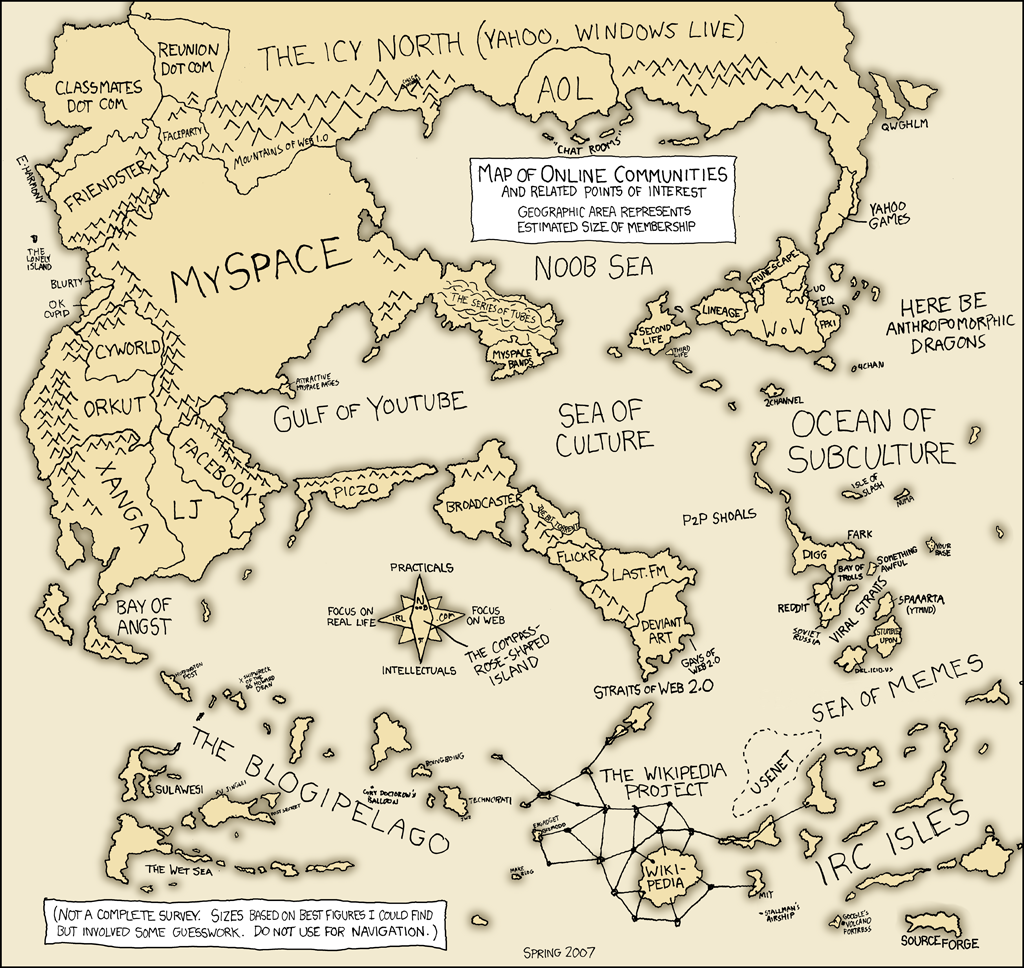
Having trouble explaining the internets and its applications to patrons and colleagues? Try this.
Having trouble explaining the internets and its applications to patrons and colleagues? Try this.
Tuesday, May 01, 2007
Random
"Ref Grunt" writes his blog in list form. Last night's shift felt like that:
no cell phone
books on Jamestown, here
stop rolling on the floor, preschooler
stop talking so loud
quieter please
no cell phone
no, we don't seem to have the movie "Gladiator"
here's how to book a study room
shush
stop
no, seriously, don't bellyflop onto our cushy chairs, 6 year old
I can kinda help you with the scanner
here's some summer reading info
shush
I can hear the music in your headphones across the building; turn it down
Closing in 15 minutes, people.
Reading: The True Story of Pocahontas: The Other Side of History, From the Sacred History of the Mattaponi Reservation People, Linwood Custalow and Angela Daniel.
On the Muzak at Ukrop's: Abba, "Dancing Queen"
Subscribe to:
Posts (Atom)